Showing posts with label Self Myofascial Release. Show all posts

Mar 8, 2013

Coach Eck's Training Session 3/8/13

by Chris Ecklund, MA, CSCS, USAW

Quick Thoughts:
  1. Another quick sessions this morning between clients and my interns. 
  2. Turned out to be shorter than I would have like as I spent more time on soft tissue (much needed today). 
  3. Throughout this journey of the last month and tracking my workouts it has reinforced a truth to me that I encourage my clients and students toward: consistency is key. Time and time again I realize that consistency trumps intensity or volume in my training. While both intensity and volume are important, it’s much more important for me to maintain consistency in order to sustain a training effect (in all facets: smr, mobility/flexibility, stability, power, strength). In short, getting in something is always better than nothing.

Mar 7, 2013

Coach Eck's Training Session 3/7/13

by Chris Ecklund, MA, CSCS, USAW

Quick Thoughts:
  1. Physically exhausted still. Joints a bit achy. Another low volume day. 
  2. Noticing numbers are staying reasonably solid and not dropping off much as long as I can get some good soft tissue and warm up sets in.
  3. Feeling pretty good on BB Bent Leg Hip Extensions.  I think some of my early struggles with this lift is BB positioning and the first movement off the floor (feeling that I'm pressing through the correct arch).  As long as I pay attention to those two things, the lift feels good and I find not lumbar shearing or stress.


Mar 5, 2013

Coach Eck's Training Session 3/5/13

by Chris Ecklund, MA, CSCS, USAW

Quick Thoughts:
  1. Today was another extremely busy day that I didn’t think I was going to be able to fit training into. Luckily an hour opened up. 
  2. Although it’s already Tuesday, I’m feeling physically exhausted. Definitely unloading and trying to peak this week if I feel well enough each day.  Since I didn't feel great today, I kept my loads about 10-20% lighter and tried to minimize my tempo. 
  3. Threw in a couple different variations today simply because I trained at Prevail and this is a training day I've been doing at UCSB over the last 2 months.

Mar 4, 2013

Coach Eck's Training Session 3/4/13

by Chris Ecklund, MA, CSCS, USAW

Quick Thoughts:

  1. Low Volume this week: similar plan as last week.  Keeping my volume as low as I can (as long as I can get warmed up enough) and trying to hit the same or higher intensity in most lifts this week.
  2. Why?  I'm exhausted (which typically comes at this point in my mesocycle) and I want to peak within reason before I unload and change my program next week.

Feb 28, 2013

Coach Eck's Training Session 2/28/13

by Chris Ecklund, MA, CSCS, USAW


Quick Thoughts:

  1. Had another opportunity to train off site by myself today.  Nice birthday gift to myself.  I enjoy training alone.  I don't have to answer any questions about work or what I'm doing in my own training.  I find I can get a lot more work done.
  2. Keeping my volume up a little bit this week but not as much as last week.  As long as I'm feeling good and can get a lot of SMR and solid warm up in, I've wanted to challenge my loads a bit.


Feb 27, 2013

Coach Eck's Training Session 2/27/13

by Chris Ecklund, MA, CSCS, USAW

Quick thoughts:

  1. Trained at UCSB today.  I must admit that is was humorous to watch people watch me do the BB Bent Leg Hip Extensions.  Though I have tried to encourage my classes to begin working on this lift...next to NO ONE at UCSB performs it.  Quite funny to watch their faces as it's a pretty conspicuous exercise.  But...great glute/adductor exercise.
  2. Had more time today, got more work done.
  3. ESD and Core work still pathetic.  Not getting either done on a regular basis.  Painfully obvious that I need to do a better job with my consistency in these areas.


May 11, 2010

Stretching: Before or After Exercise?...the debate continues

 By Juliann Boubel, BS, CSCS


Most Americans grew up hearing that we needed to stretch before exercise in order to “loosen up” and prepare our muscles for activity. It has been found in recent years, however, that this type of warm-up is not only counter productive before an activity but potentially harmful. While many of us began each PE class stretching in a circle before a rowdy game of kickball, scientists are now seeing that this sort of “static” stretching is having the adverse effects. When a “cold” muscle is put on stretch before starting an exercise, it actually tightens that muscle rather than loosens it and can cause muscle tears or strains. Think of your muscles like a rubber band that has been stretched too far--it loses its elasticity and, like muscles, cannot be contract back to normal quickly. In fact, it can take up to an hour for stretched muscles to regain their optimal length for performance! If you are playing an explosive sport, like basketball for example, after static stretching, your power and explosiveness can be significantly diminished through static stretching pre activity.

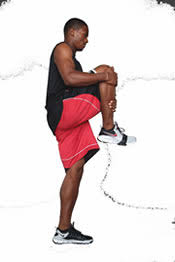
Does this mean we should just stop warming-up and stop stretching all together? Hardly. In a field of ever evolving information and discoveries, we are finding that this is an area that is getting a much-needed revamp. Warming-up needs to be something that gets your blood pumping and muscles ready to go. A five-minute light jog, a few sets of jumping jacks or sport specific activities like a few practice serves at tennis can go a long way. Prepping muscles for activity through these movements are known as active or dynamic stretches. Specifically we are talking about mimicking movements that will be used during a sport activate multiple muscle groups. Often one muscle may be stretched while the antagonist (opposite) muscles are working (think walking knee hugs: stretching hamstrings and glutes while contracting hip flexors). Moving through sport specific motions and dynamic activities better activate muscles for any activity from dancing to football.

Now, before you put an end to ALL static stretching, know that it still holds benefit. It is all dependent upon when you stretch. Once an exercise or workout bout is complete, feel free to spend time touching your toes and stretching your triceps during your cool down. This is the time research is finding great value for static stretching. It can help relax muscles and relieve tension accumulated during a work out. Stretching also increases joint flexibility and circulation, which helps speed muscle recovery.

At Prevail Conditioning Performance Center we take our clients through a thorough Self Myofascial Release, Corrective/Active-Isolated/Mobility Stretch, Activation and Movement Prep before every workout session and conclude with Static, Neuromuscular or Active Isolated Stretching Post Workout.

Prevail Conditioning will be offering a midday stretching class starting soon for any interested in learning more on how to safely and effectively use stretching to relax muscles, increase flexibility and improve circulation.


Julian Boubel, BS, CSCS is a Strength & Conditioning Coach for Prevail Conditioning Performance Center and works with athletes and fitness enthusiasts alike.  For further information regarding this topic please contact Juliann Boubel, BS, CSCS at Juliann@prevailconditioning.com.


References:
1. Foster, Mary Ann. "13 Tips for Stretching Sanity." Massage & Bodywork 20.5 (2005): 58-59.
2. Cheng, Maria. "Stretching could be harmful. " McClatchy - Tribune Business News, April 18, 2010.
3. Ecklund, Chris. “When is the Best Time to Stretch…and How.” www.prevailblog.com. December 7, 2007.
4. “Experts Don’t Stretch Before Exercise.” April 15, 2010. www.usatoday.com/news/health/2010-04-15-stretching-muscles_N.htm

Apr 6, 2009

Therapeutic Massage at Home

Here is something you may be interested in...

A colleague of mine, Kathy Gruver, MS, LMT, RM, has recently come out with an instructional DVD for at home massage. For those of you looking to learn some practical techniques you can use on your own, this might be a good option for you.

I am always looking for ways of doing self myofascial release, foam rolling, etc. for my clients pre-, during and post-exercise to improve neuromuscular communication and recovery. But in the end, they are all "the poor-man's massage" techniques. This is an opportunity to learn some more practical/scientifically-based techniques you can use at home and still save some bucks in our wonderful economy. I have had the opportunity to meet with and discuss some of these issues over the last couple years with Kathy and have found her to be a great resource of information.

Here's the link to Kathy's site: Therapeutic Massage at Home DVD

Feb 28, 2008

Mini Circuit Program

Only have 20-30 minutes 2 - 3x/wk for exercise? This is the program to help you lose bodyfat and increase fitness.

Day One

Outline (Example Exercise)
1a. Combo Lift (Squat - Bi Curl - Shoulder Press)
b. Bridge (Prone Bridge w/ Y Reach)
c. Combo Lift (Cable Squat – Row)
d. Abdominal Crunch (Bicycle Crunch)
e. Balance (Single Leg Balance Eyes Closed)
*SMR or Cardio/Agility Interval (2 min Bear Crawl 10 yds - Crab Walk 10 yds - Run 10 yds)

2a. Combo Lift (Push Up – Row)
b. Bridge (Side Bridges w/Abduction)
c. Combo Lift (MB RDL – Dead Lift – Overhead Squat)
d. Abdominal (Standing BB Russian Twist)
e. Shoulder PreHab (Bodyblade Sagittal Plane 90˚ Abduction)
*SMR or Cardio/Agility Interval (SMR Latissimus Dorsi)

Day Two
Outline (Example Exercise)
1a. Combo Lift (SL RDL to Row)
b. Bridge (Supine Bridge Elbows on Bench)
c. Combo Lift (Cable Split Squat – Chest Press)
d. Core (Cable Lift)
e. Balance (Single Leg Balance Triangles)
*SMR or Cardio/Agility Interval (SMR ITBand)

2a. Combo Lift (Pull up – Hanging Ab)
b. Draw In (Dead Bugs)
c. Combo Lift (Double Leg Hip Lift – DB Chest Press)
d. Core (Cable Chop)
e. Power Lift (Push Press)
*SMR or Cardio/Agility Interval (60 second Jump Rope)

Exercises performed in succession (i.e. set of A, set of B, set of C, D, E, SMR/Cardio Agility…repeat). All exercises in each group performed with no time between.

Sets: 2-4
Reps: 6-10 (strength/power), 8-12 (general fitness, bodyfat decrease)
Frequency: 2-4 days/week (must alternate days)

Feb 27, 2008

Tri Set Program

Great Program to Lose Fat/Get in Better Shape

Day One

Program Outline (Example Exercise)
1a. Vertical Pull (Chin Up)
b. Squat Variation (BB Front Squat)
c. Prone Bridge (Double Arm/Leg)
*SMR or Cardio/Agility Interval (30 second each SMR ITBand)

2a. Vertical Push (Single Leg Standing Shoulder Press)
b. Hamstring Hip Variation (Roman Chair Hip Extension)
c. Supine Bridge (Double Leg/Shoulder Blades on Swiss Ball)
*SMR or Cardio/Agility Interval (60 second Jump Rope)

3a. Vertical Pull (Alternating Extended Lat Pulldown)
b. Squat Variation (BB Back Squat)
c. Side Bridge (Double Leg on floor)
*SMR or Cardio/Agility Interval (30 second each SMR Piriformis)

4a. Vertical Push (Handstand Push up)
b. Hamstring Bent Leg Variation (Double Leg Hip Lift)
c. Calf/Lower Leg (SL Calf Raise or Toe Raise)
*SMR or Cardio/Agility Interval (60 second Slide Board)

Day Two
1a. Horizontal Pull (Inverted Row)
b. Abdominal Crunch (Ab Roller)
c. Single Leg Squat Variation (Step Up)
*SMR or Cardio/Agility Interval (30 second each SMR Pectoralis Major)

2a. Horizontal Push (Foot Elevated Push Up)
b. Spinal Extension (Back Extension on Swiss Ball)
c. Hamstring Bent Leg Variation (Leg Curl to Hip Lift on Swiss Ball)
*SMR or Cardio/Agility Interval (60 Second Stair Stepper or Step Mill)

3a. Horizontal Pull (Standing BB Row)
b. Quadrupeds (Opposite Arm/Leg on floor)
c. Single Leg Squat Variation (Kettlebell Split Squat)
*SMR or Cardio/Agility Interval (30 second each SMR Lateral Gastrocnemius)

4a. Horizontal Push (DB Alternating Extended Bench on Swiss Ball)
b. YTWL (Prone on Floor)
c. Hamstring Hip Variation (RDL)
*SMR or Cardio/Agility Interval (60 second Rowing Machine)
Exercises performed in succession (i.e. set of A, set of B, set of C, SMR/Cardio Agility…repeat). All exercises in each group performed with no time between.

Exercises performed in succession (i.e. set of A, set of B, set of C, SMR/Cardio Agility…repeat). All exercises in each group performed with no time between.


Sets: 2-4
Reps: 6-10 (strength/power), 8-12 (general fitness, bodyfat loss)
Frequency: 2-4 days/week (must alternate days)

Feb 4, 2008

It's Simple: Stop Resting/Work Harder/Do More Table Pushaways

"I've been walking 3x/week for 3 hours and I can't lose any weight."

"I lift weights for 1 1/2 hours - 2 hours 4x/week and I can't gain any muscle or get definition."

You think I'm kidding, but people actually tell me this stuff. And here's the kicker...they're not lying. This is the truth.

As you well know by now (hopefully), the main issue with Americans gaining weight and having a variety of cardiovascular related disease issues is that we eat too much and don't exercise enough. It's not really rocket science. The equation hasn't changed much over the past decade:

Burn More Calories than consumed/day = Weight/Bodyfat Loss

Consume More Calories than Burned/day = Weight/Bodyfat Gain*
*this is in the absence of hypertrophy-type exercise

What about all the hormonal issues, genetic and metabolic issues that people are dealing with that may lead to weight gain? Yes, they exist, but I think we have been putting a bit too much emphasis on those issues over the last couple years. If you're following the above equation and can't lose bodyfat, then go to your physician and get a physical to find out if, in fact, you do have something medically that must be dealt with. Otherwise...get to work.

So what's with "Stop Resting/Work Harder/Do More Table Pushaways?"


First, let's agree that everyone has the same 24 hours/day. So be honest and decide what is realistic for you to achieve with health/performance goals with the time you have to spend. If your goals are out of balance with the time available, you either need to sacrifice time in other areas so you can use it for exercise or modify your goals to match your time. Now let's get down to it.

1. Rest Less = Burn More
I love it when I see people in the health club sitting around reading the paper in between sets, or even when they are doing cardio. Then the same person makes one of those statements up above. Anyone home? Of course you can't hit your goals...you're wasting too much time.

Mistake #1: Most people rest too much in the gym. It is more beneficial to rest less and work more in the gym.

When you're in the gym, stop resting. The goal is to burn calories to create that caloric deficit (and increase Excess Post Exercise Oxygen Consumption...but that's for another blog). You're not in high school anymore. You're not not trying to become Mr. Olympia (I hope). So stop worrying about how much you can bench or how big your biceps are (in truth, nobody really cares anyway). Use your "rest time" effectively. I hate it when people tell me they don't have time for core or cardio or balance training or corrective exercise work. YES YOU DO! Do it during your down time.

Instead of doing what I call a Straight Set routine (do a set of reps, rest, repeat), start doing Tri Sets or Mini Circuit workouts.

Tri Set = 3 exercises in a row
(see Tri Set Routine blog for examples)

Mini Circuit = 4 - 6 exercises in a row
(see Mini Circuit Routine blog for examples)

By the way, if you're holding on to the handles on the cardio machine for dear life, you're not burning more calories...you just beating the heck out of your joints.

2. Work Harder
Another favorite statement is the "I do cardio for 3 hours everyday" claim. If it's actually true...great. But if you're not seeing results...not great.

Mistake # 2: Putting in the time but not the effort to burn enough calories (and see results).

If you do one of the workouts I just recommended, chances are your intensity will automatically go up. But, it is still important to to simply work harder. If you are working at intensities that do not challenge you to a level of fatigue, you're probably not working hard enough. This is true of resistance training and cardiorespiratory activity. No challenge = Body has Adapted = Less Calories Expended = Less Results.

If you put the concepts of Work Harder and Rest Less together, you should get the idea of more workout density. That is what you want...more bang for you buck...more calories burned in less time.

3. Table Pushaways
Can't take credit for this one. Got this idea from Mike Boyle (Nationally Renowned Strength & Conditioning Coach). Here's the final deal: if you want to get in caloric deficit to lose bodyfat, it is a lot easier to NOT eat 500 calories/day than to eat it and have to BURN an extra 500 calories/day.

Why? Takes one decision not to eat 500 calories. Takes about 30-60 minutes (depending on exercise intensity) to burn off 500 calories.

So do some table pushaways and don't eat as much. Eat 5-6 smaller, balanced macronutrient meals each day.

Dec 3, 2007

When is the Best Time to Stretch...and How?

Written for SB Fitness Magazine
By Chris Ecklund, MA, CSCS

I like this question. I do. It always makes me laugh. We all know the unspoken question being asked here, right?... “Do I really have to stretch at all, and if so, how little can I do and still be okay?”

For those that read the article I wrote addressing the importance of warm up and cool down, my answer is very similar here: I find that the older I get, the more important stretching becomes (probably because I didn’t do enough when I was younger). Ideally stretching should be a part of our routine from the get-go. However, when bodies and minds are young the feelings of invincibility and rapidly recovering muscles often discourages it…so we are left with the aches and pains to enjoy 20 years later. Good deal, huh?

A couple quick background thoughts. First, why do we stretch? Most often the default answer is ‘to avoid injury.’ Understand, however, that most reviews of literature in the area of flexibility training would likely agree that there is not a strong correlation between static stretching (the type where you ‘hold’ the stretch) and acute injury reduction. Is it probable that it does help at all in the area? Sure. But not a primary result as per the literature. This begs the second question…if not for injury prevention, then why? The primary reasons we find in current literature center around improved posture, decreased chronic injury or pain (i.e. low back pain), improved movement economy (your body moves more efficiently and doesn’t fight itself), and decreased recovery time. And just like all other fitness or exercise-related questions, the goal of the ‘stretching’ or ‘flexibility’ training would determine the type of stretching and the appropriate placement in an exercise session. Here are the most common stretching techniques as well as when, how, and why to use them:

Static Stretching: This is what most people are familiar with. It is the stretch that you “hold.”
Goal: lengthen the muscle and associated connective tissue to allow greater range of motion. Necessary for maintaining proper posture and allowing full range of motion in activities of choice. Decreases recovery time.
How: with proper posture and alignment, stretch the muscle to the point of discomfort (not pain) and hold the position for at least 20-45 seconds. Keep the muscle relaxed and maintain slow relaxed breathing patterns. Perform 2-3 sets on appropriate muscles.
When: if you are only going to do it once during your routine, do it at the end of your workout. You can also stretch in between sets of an exercise to maximize your workout time. Also, it may be appropriate to stretch prior to exercise also. However, if you are focused on building strength or power, static stretching is not recommended between sets or immediately pre-activity as most research shows decrements in these variables for up to 60 minutes post stretching.

PNF or Neuromuscular Stretching: this is often referred to as the “Hold-Contract-Relax” method. Though there are other methods of Neuromuscular Stretching, this is the most common. Most literature would agree that, if done correctly, Neuromuscular Stretching is slightly more effective than is Static Stretching.
Goal: Same as Static Stretching but perhaps a more aggressive approach.
How: with proper posture and alignment, stretch the muscle to the point of discomfort (not pain) and hold the position for 5-10 seconds. Then perform an isometric contraction of the muscle being stretched (this will increase the feel of the stretch as well as decrease some of the neural inhibitors) for 5-10 seconds. Then, relax and take a deep breath and move to the new point of discomfort (this is usually 5-10 degrees further each time). Repeat this pattern 2 or 3 times. Keep the muscle relaxed and maintain slow relaxed breathing patterns. Perform 2-3 sets on appropriate muscles.
When: research here is similar to Static Stretching with respects to timing, and for similar reasons.

Dynamic Stretching: This is often referred to as calisthenics or movement-oriented warm up.
Goal: increase muscle and connective tissue temperature, range of motion, blood flow to the working muscles (more nutrient supply) and increase neural drive to working muscles. In essence, to prepare the muscle for the activity it is about to encounter.
How: in the simplest terms…start with small slow movements and gradually progress them to bigger and faster movements. Engaging in movements similar to that which you are about to engage in are most beneficial (i.e. don’t go skip to warm up for swimming). In attempting to warm up for most ground based sporting activities, movements like body weight squats, gradual sprint build ups, side slides, skipping, cariocca, etc. types of activities work well.
When: more research and applied science encourage this type of “flexibility” training pre-activity. Why? You don’t lose strength and power. It makes sense, doesn’t it? Why would you teach your muscle to relax (static stretch) before trying to get it to contract quickly and powerfully? I don’t know either. If you figure it out, let me know. Point?…prepare the body for what it is about to encounter. It may also be wise to perform this type of activity as a “cool down” post exercise to shuttle waste out of the body and decrease recovery time.

Self Myofascial Release: a technique that has come to some popularity over the past 5 years. It is ultimately utilizing various tools (a foam roller, a “Stick”) to apply self-massage. In truth, it is not stretching, per se, but it does have significant benefit for range of motion which is why it’s worth mentioning here.
Goal: to break down trigger points and/or knots within the muscle as well as adhesions between the fascia (tissue surrounding muscle) and muscle itself. When either of these are present, range of motion is affected due to inhibited neural communication with the muscle and connective tissue preventing movement.
How: utilize tools such as “The Stick,” a 6” Foam Roller, or anything relatively firm (tennis ball, medicine ball, etc.). If using a Foam Roller, lay the appropriate muscle atop the roller and attempt to work out any sensitive areas that are encountered. Use as much pressure from bodyweight as can be tolerated while maintaining a relaxed muscle and breathing pattern. Work out the worst areas first. Perform 2-3 sets of 30-60 seconds per muscle.
When: SMR techniques can be applied pre-exercise, in between exercise sets, or post exercise. If you only have time for one application, pre-exercise is probably the best option.

Example routine for “General Fitness”
Dynamic Warm Up 5-10 Minutes
Static Stretching or SMR Techniques 5-10 Minutes
Exercise
Static Stretching between sets
Dynamic Cool Down 5-10 Minutes
Static or Neuromuscular Stretching 10-15 Minutes

Example routine for “Athletes”
Dynamic Warm Up 10-15 Minutes
SMR Techniques 5-10 Minutes
Exercise
SMR Techniques between sets
Dynamic Cool Down 5-10 Minutes
SMR Techniques 5 Minutes
Neuromuscular Stretching 15-30 Minutes

Apply these techniques to your program for 1-2 months and you will notice significant benefit.

Consult a physician prior to beginning any exercise program and stop at the onset of any pain or dizziness.

Sep 10, 2007

How important is the warm up and cool down in each cardio workout?

As I get older, I find that my answer, increasingly, is “more and more important!” In truth, performing a proper warm up and cool down for each cardio workout provide a variety of benefits. First, understand that a “proper” warm up and cool down that will enable maximum benefits depends on several variables such as current fitness level, age, activity to be performed, goal of the activity, etc. However, most literature would agree that for a recreational/intermediate exerciser a warm up lasting 3 - 15 minutes of continuous movement is appropriate. This warm up should gradually increase in intensity until the desired training intensity is achieved. Note that the warm up should, with few exceptions, be performed doing the same activity that will be performed during the training. A quick reference here to whether or not stretching should be a part of this routine. Most literature is now showing agreement that static stretching pre-activity may not significantly reduce injury and may actually decrease performance of activities involving power or speed (i.e. most sporting activities). So if those are your goals, spend the majority of your warm up performing activity specific movements and possibly utilizing a foam roller or “The Stick” for self-myofascial release to increase ROM [Range of Motion]. But if you’ve got an emotional attachment to static stretching... go for it! The benefits realized from warm up?

a. Increased utilization of fat for energy: allows for more efficient decreases in body fat and greater duration of cardio workouts.
b. Increased muscle temperature: decreases risk for injury and allows faster muscle contraction and relaxation.
c. Increased vasodilation/blood flow to working muscles: allows more oxygen and nutrients to reach muscle and clears wastes increasing exercise performance.
d. Decreased viscosity of joint synovial fluid: decreases joint friction.

Here’s an analogy I often use. Ever pull a rubber band out of the freezer and try to use it? If so, you’ve probably noticed that it is far more fragile and does not recoil as quickly when you stretch it. In many ways your muscles respond the same way without a warm up. The cool down should mirror the warm up in length and activity and provides much of the same benefits in reverse.

a. Gradual decreased blood flow and heart rate: decreases incidence of dizziness and fainting.
b. Clears wastes and byproducts from working muscles: decreases recovery time.
c. Decreases Delayed Onset Muscle Soreness: less soreness is experienced in the days following workout bouts.

I am a firm believer in the “something is better than nothing” philosophy of exercise. But there is also tremendous longterm value in adding a few extra minutes of warm up and cool down to increase performance and decrease recovery.

Written for SB Fitness Magazine Winter 2007 Issue (click here to visit site)