Showing posts with label Beyond Training. Show all posts

Sep 22, 2011

Training with a Giant

By: Chris Ecklund, MA, CSCS, USAW

He showed up to Prevail Conditioning on his motorized skateboard, wearing jeans, a t-shirt and skater shoes.  Tom (my physical therapist) told me he was a little guy, but I thought surely he was exaggerating.  Then Jeff walked in…all buck forty-five (145 lbs) of him. 

“How can this guy beat up on guys that outweigh him by 50 pounds,” I thought.

Then I searched Jeff on YouTube and watched some DVDs he let me borrow and sure enough – one guy after another no matter how big, Jeff beat up on or submitted them all.

Jeff came to us in May of this year to improve his strength and conditioning so he could take himself to the next level in his sport (Brazilian Jiu Jitsu).  Jeff was already the top American fighter and fifth in the world.  However, he had not competed as well as he would have liked to at the previous World championships (Abu Dhabi) and was looking for the next supplement to his training to improve his competitive edge.

Over the course of the first few months of training, Jeff had made several offers for me to do a private Jiu Jitsu lesson with him.  At first I put it off as I wasn’t sure if Jeff was genuine or just being nice.  After getting to know Jeff those first few months I quickly realized two things: he had a true love for his sport that he wanted to share with me and Jeff is truly genuine…period. 

I still didn’t do it.  After another month or so of his biddings, I eventually submitted and scheduled a session with him.

So, in I went.  I wasn’t sure how to dress or act (I’ve never been involved in any kind of martial arts or self defense training).  I felt completely unsure of myself.  Of course, I was also nervous as I had—up to this point—been the expert and Jeff the student.  Now the tables were turned. 

Jeff was excited as always at the start of a training session so in we jumped.  Jeff did a fantastic job and I was quite impressed with his natural coaching and pedagogy knowledge.  We moved through (what seemed to me) a tremendous amount of information and I had a great time learning from him.  Finally, he finished with some short bouts of “rolling” (wrestling) with the two of us so I could practice what we’d covered that day.

Sixty minutes later I was fatigued and dripping with sweat (two of my favorite things about exercise). 

When I walked out the door I began thinking about why I had put off this lesson so long.  I had a blast learning from Jeff and from switching the roles he and I normally play.  After a few moments of honesty with myself the procrastination became abundantly clear…

1.  I was fearful of being in a new environment
2.  I was fearful of performing poorly
3.  I was fearful of not learning fast since I consider myself a kinesthetic learner and a movement expert
4.  I was fearful of switching roles and being the learner and no longer the expert
5.  I was fearful of “losing” to Jeff when we rolled

…I was just plain fearful of looking like an idiot and had completely unrealistic expectations of myself

Why do people avoid exercise or a strength and conditioning program?

Why do people avoid getting on a good nutrition plan?

All of the things I’ve been preaching to my clients over the years I’m as guilty of as anyone (just in a different area).  I did and thought the same stuff.

I left the gym encouraged after my session that day.  I became the student and humbled myself.  It wasn’t fun to walk in the door, but it was fun after I got in and when I left.  It was hard to get there and hard to do it.  I was frustrated with myself for not being “perfect” at everything.  I felt stupid and out of place.  I felt all the same thing that our new clients feel.  But I did the simple thing I knew we ask our clients to do and that we ALL need to do on a daily basis in order to continue moving forward: be humble, learn and give effort consistently.

Two final thoughts:

1.   Our clients are awesome.  I’m encouraged at the number of people—be it a 60 year old female looking to regain health/fitness or our world class athletes—who are willing to humble themselves and become the learner again.

2.    Don’t be held back by foolish fears.  Be nervous/anxious/fearful…fine.  But don’t be limited by those things.  Yes, it is rough on the front end.  No argument.  I get that.  But it gets easier and easier.  Commit to the process.

Apr 25, 2011

The Structural Functionalism of Sport in America PART 1

By: Juliann Boubel, BS, CSCS

There are many institutions in society that exist to better human existence. Institutions like politics, economics, religion, marriage and family, and education are all individually distinctive but important in their relation to the whole, working network of society. This article argues the validity and necessity of sport as one of these valued institutions within America, created and maintained for the betterment, development, and unification of society. 

Sport is a huge industry throughout the world that unites everyone involved. The institution of sport in America serves many purposes, and I believe there are five major areas of influence under the umbrella of this organization. Sport acts as a means of mobility and socialization as well as being integrative, socio-emotional, and political. To start, the mobility of sport can be seen through the ladder of success it can provide its participants. For example, sport has provided great means of social mobility for those from low-economic backgrounds as a way to the top of the social hierarchy through affluence and education. College scholarships can provide access to education for individuals who otherwise would not be able to afford such learning or opportunity. Even though he was cut from his high school basketball team, Michael Jordan is one of these individuals who beat the odds and received a scholarship to his dream school of UNC. After being named College Athlete of the year twice before his final season, he was drafted in 1984 by the Chicago Bulls and has since become “the greatest basketball player of all time” (1).

Because sport creates this bridge between economic classes, 
its mobility helps unite our country and 
give potential opportunity for all athletes to succeed.

Socialization of sport relates to how it molds and shapes people into appropriate, capable members of society. The camaraderie found in sport is a unique aspect that brings people together and teaches them how to act in social situations. Formal and recreational sports teach qualities like teamwork, sportsmanship, honesty, and integrity, all of which are highly valued characteristics in well-developed individuals. According to Foundations of Sport and Exercise Psychology, “character-developing benefits of sport contend that participants learn to overcome obstacles, cooperate with teammates, develop self-control, and persist in the face of defeat” (2). The authors state that...

sport and character relate within the context of four intertwined truths—
compassion, fairness, sportsmanship and integrity. All of these qualities combine 
to form and shape character through the participation in sport 
and teach individuals how to function as a team on the field, in the gym or at the office.

See Part 2 of this Article NEXT MONTH.


Juliann Boubel, BS, CSCS is a Strength & Conditioning Coach for Prevail Conditioning Performance Center and works with athletes and fitness enthusiasts alike.  For further information regarding this topic please contact Juliann at Juliann@prevailconditioning.com. 


  1. "NBA Encyclopedia: Playoff Edition." NBA Media Ventures. 2009. 27 Apr 2009.
  2. Weinberg, Robert S., and Daniel Gould. Foundations of Sport and Exercise Psychology. 4. Champaign, IL: Human Kinetics, 2007. Print.
  3. Bell, Katie K. "Boost Your Brain Power." Today's Chiropractic Lifestyle 36.1FEB/MAR 2007 34. Web.25 Apr 2009.
  4. "History of Title IX." titleix.info. 2009. The MARGARET Fund of NWLC. 25 Apr 2009.

Who's the Musculoskeletal Expert...Your Physician or Your Physical Therapist?

By: Tom Walters, DPT, CSCS

I hope the answer to this question does not surprise you, but your physical therapist is the correct choice!


A study published in the BioMed Central Journal of Musculoskeletal Disorders tested physical therapists, physical therapy students, physicians from a variety of specialties, medical residents and medical students on their knowledge of musculoskeletal medicine.  The study showed that physical therapists with or without board certification and physical therapy students in their last year of school scored higher than medical residents and all physician specialties except orthopedic surgeons (see graph below).


The results of this study would probably surprise many consumers of physical therapy services, which is something we as therapists need to change.  Personally, I have discussed this topic with many individuals and constantly find that people are shocked at the level of education required to become a physical therapist and are even more dumbfounded when they find out that therapists often complete residencies and fellowships.  As therapists, we must do our best to educate patients on what it means to be a physical therapist and always take the time to explain musculoskeletal concepts as they relate to a patient’s particular diagnosis.  By doing so, we will be better serving our patients and promoting the profession.

With these results of this study in mind, I ask that the readers of this article support direct access legislation to physical therapy services. Most states have already passed some form of direct access, which means the consumer can go directly to a physical therapist for musculoskeletal problems without having to spend extra time and money by having to see their physician first. However, some states have not passed direct access or have a restricted version at this time.

For more information on direct access and to see what is going on in a particular state, please follow the following link from the American Physical Therapy Association.


Tom Walters, DPT, CSCS is an orthopaedic and Redcord certified Neurac suspension-exercise physical therapist at Prevail Conditioning Performance Center.  Tom has experience in orthopedic private practice, long-term care, traveling therapy and sport medicine.  For further information regarding this topic, please contact Tom at tom@prevailconditioning.com

May 7, 2010

About a year ago...


It was one year ago today I posted some thoughts on integrity and the joy and pleasure I have in having the opportunity to be around people on a weekly basis who exemplify that trait.  I was reminded of this again this morning.  I was further reminded this group of people exemplify character, humility, passion, commitment and a life spent investing in others.  Most important, they exemplify Christ.  Namely, the Westmont College Kinesiology Department Faculty and Staff.

This morning I was invited again to the Westmont Kinesiology Department breakfast for graduating Seniors.  Over the last couple years I have been fortunate be an Adjunct at Westmont College.  This year was a bit more special for me as I had the opportunity to be more involved in some teaching and get to know more of the graduating seniors.  Sitting and listening to parents, grandparents and students share their thoughts and hearts at how they had been impacted by the faculty in the department was both humbling and inspiring.  As I listened I realized that my own experience has been (and continues to be) very similar to theirs.  I am continually uplifted, encouraged, spurred toward growth, offered wisdom and insight about the balance and purpose of life, and share times of both grief and laughter that come with living. 

Today I realized something further, though.  I realized (and was reminded by a faculty member) that the students have had a significant impact on me as well.  I have been amazed with the students I have had the opportunity to get to know and share time with over the past 2-3 years.  Young people with hearts and minds that have encouraged me in my life, challenged me to learn, reminded me to have fun, and impressed upon me the continued need for those who lead lives of significance through character, integrity and a life seeking Christ.  They remind me that a life spent doing anything else is a but a waste.

Thank you again to the Kinesiology Department Faculty and Staff.

Thank you Kinesiology Graduates of 2010...
                ...especially those of you from the KNS 160 class!

Blessings and honor and peace.

Chris Ecklund, MA, CSCS, USAW

Apr 5, 2010

It's Not As Difficult As We Make It...

by Dayne Gingrich, Mental Skills Coach

90% of everything we do is a habit. 

We create those habits through massive, massive repetition... consciously and unconsciously. If we can create bad habits through such repetition, we can also create new, better habits through the same process.

The challenge is taking the necessary action to repeat the good habits over and over.

In order for anything to manifest, we must first make a conscious decision to want it to happen... this may be one of the most difficult things we do. Making that concrete decision isn't easy, and is what holds many of us back from achieving new and better. We know we "want" something different, but too often, lack the courage to commit to that decision that will create a shift in our mindset.

The biggest mistake I see every day is people trying to "change bad habits." Trying to change the habit actually makes us focus more attention on it, resulting in an even stronger bad habit. We spend so much time on the habit we don't want, we ironically make it more powerful.

Instead, we should concentrate on CREATING NEW habits.
Figure out what we want... repeat over and over.
Sounds simple? It is!
It's so simple, most completely overlook the ease at which these new habits materialize.
Clarity is very often too clear to see.


Dayne is the owner of Coach Your Mind, where he trains all levels of athletes to maximize their mental and emotional skills during competition. He’s a former professional tennis player, who has been competing at elite levels his entire life. He was recruited to play Division I basketball out of high school, and became a scratch golfer in his 20’s.  While actively competing, he immediately recognized the mental game wasn’t being pursued as widely as the physical. His goal is to change this specific focus for athletes… helping them realize the mental game is a powerful weapon that, when balanced with the physical, will separate the great from the average.

Email Dayne: dgingo@cox.net

Sep 29, 2009

Santa Barbara High School Football Hell Weeks

This August I had the opportunity and pleasure of working with the Santa Barbara High School football program. I am truly pleased to say that my time with the SBHS coaching staff was probably the best experience I've had with a coaching staff from any sport at any level. The coaches were open and trusting to turn the reigns of all the Strength, Performance and Conditioning work over to my staff and me. Rare. Aside from that their communication with myself and coaching staff was excellent. Their desire to do what was best for their team(s) and begin the building process (during a rebuilding year for their program) of developing safe and efficacious training practices is truly admirable. I know that this season is going to be a long haul for them but am quite certain that with the desire and concern for doing what is best for their program, they will quickly be where they desire to be.

Hats off to Coaches Jaime Melgoza, Doug Caines, Sean Simms, Char Vandaele (ATC), and all of the other coaches whose names I've missed.

Below you'll find some of the footage from the training we did on site:


May 11, 2009

8:02pm

Tonight one of those events happened that forces a person to stop and reflect.

One of the friends from my youth passed away. Cancer. 33 years old.

It can be a pretty painful thing to reflect on, the loss of a friend. I think mostly of her family, her husband, her young boy. And yet for me there are also joys in the midst. I know that she is no longer in pain after years of battling. I know that I will see her on the other side. I know that she is with my Heavenly Father.

But as I mentioned, it does cause one to reflect...on the meaning of life, on the significance that is given (or should be given) to the activities we engage in each day, on what is of true value and worth.

It was quite something to watch Monica live her life from a distance the last couple years. She modeled to me that "to live is Christ," a concept I struggle with.

Blessings and peace to you Monica.

May 8, 2009

Integrity

I don't have a tremendous amount to say here...

I have simply been shocked as of late at the lack of integrity that exists in our world, in our society, in my field. There have been some conversations I've had over the past couple years and even recently that have truly made my heart sink at the reality of this situation.

To have integrity is not easy. It is most certainly the road less traveled. But I have found that it holds tremendous weight.

I had the opportunity to attend the Westmont Kinesiology Department breakfast for faculty and graduating Seniors this morning. Listening to words shared by faculty, students, and parents of students was deeply impactful. In light of the conversations I mentioned, hearing words that exemplified integrity was absolutely refreshing. To know that there are still those who desire to uphold this ideal is an encouragement to me.

Apr 1, 2009

Santa Barbara Golf Academy coming this May!


Prevail Conditioning is excited to announce a joint venture with PGA Professionals Richard Chavez and Dave Thornton and Santa Barbara Golf Club.

Beginning this May, we will initiate a program that will be the first of its kind for golfers in the Santa Barbara area.

Dave Thornton and Richard Chavez will bring decades of expertise in the areas of swing mechanics, golf strategy and sports psychology. The exciting addition to these One Day Seminars will be benefits of power production, postural correction, fine motor control, and joint mobility and stability. As these concepts are becoming more prevalent in the literature and golfing world, our goal is to add a component and perspective to our attendees that will be like none other.

Details for the Santa Barbara Golf Academy / All Day Golf School
1 Hour Seminar/Breakfast at Mulligans Restaurant
2 Hours Golf Instruction with PGA Pros Richard Chavez/Dave Thornton
1 Hour Corrective Exercise / Strength & Power Instruction with
Performance Coach Chris Ecklund
18 Holes Golf
Tuesdays starting in May 2009!

For further information or to Register, contact:
Dave Thornton at 805.687.7087 / teeeoneup@aol.com
Richard Chavez at rchavez@pga.com
Chris Ecklund at 925.285.0924 / chris@prevailconditioning.com

Dec 8, 2008

Fads Drive Me Nuts

written for CBN.org
By Chris Ecklund, MA, CSCS

No Carb Diets
CrossFit
The 300 Workout
Juice Diets
The “Lose 12 pounds in 5 Days” Diet
Low rise jeans, baggy jeans, skinny jeans
Tattoos

The next infomercial…?


Those that know me could have probably guessed it and are happy I’m admitting to it. I don’t know that there is anything I possess that would qualify as “trendy.” I just can’t do it. It kills me to buy stuff that I know will go out of style or be worthless in a year or less. My shorts aren’t too long, too short, too baggy, too tight… Call me cheap. Call me getting old. Whatever. It’s probably all true. I’ll accept all of the accusations.

I’ve been in the fitness and Strength & Conditioning industry long enough to see that fads and trends just keep making their way into mainstream thought. What’s more frustrating than that is the fact that many of them are just re-packaged trends of what came through about 10-20 years ago.

Here’s a little prophetic statement for you:
High Carbohydrate diets will once again become popularized as the key to health and wellness within the next 10 years.

I have no idea exactly how or why it will happen, but that’s my prediction. It’ll be quite humorous to see us go from a Carb-hating to Carb-loving society within 10 years. But I figure we’re already half way there, so…?

Doesn’t matter what we’re talking about in the industry, we just keep seeing the patterns repeat. The two most frustrating parts of these fads or trends are:
1. They usually claim to be the answer for everyone (no matter what the age, gender, goals, or history).
2. They are often based on a little bit of research that is blown out of proportion.

Now I know that often blogs are a place where people can safely (but inappropriately) bash others or other’s thoughts. So before any CrossFit counterparts get up in arms about where I’m going, let me say that it is not my intention to do so. I would simply like to offer some thoughts that will help bring some perspective and balance to the forefront.

Fads and trends (especially in the fitness realms) are truly a frustration to me primarily for the 2 reasons I mentioned above, but also because they only last for a few months (to a couple years) and then they’re gone. After that we often never hear of them again or perhaps figure out a way to reinvent them when we get bored of everything we’ve been doing in about a decade. I

It begs the question…”Then how could they have been ‘the best’?”

The vicious cycle I see that ensues is:

1. Excitement about the “best new thing.”
2. Buy or engage in “the best new thing” until it stops working or we get bored to death.
3. Look for the “best NEW new thing.”

Of the research I read and colleagues who I respect and follow, there is a significant theme that continues to arise which has no relevance in the world of fads and trends…GOAL ANALYSIS and PROGRESSION.

Improving oneself takes time, effort, focus, consistency, and some planning. None of these are pretty or flashy…which is why they don’t sell. But here’s a surprise: they work. And that’s why I often have (and hear about others) clients come to me telling me nightmare stories about pain and injuries that happened when they tried a product or program that wasn’t right for them—but was the “best new thing”—(or best case scenario…stories about program or trainers that didn’t work)

On CrossFit...it’s popular right now so I often have to deal with the questions. Here’s where I’m at right now. I think there are some really intelligent people following some great research and applied science who are involved in CrossFit. And—just like many other personal trainers in clubs out there—there are also many people who are simply jumping in with both feet who are not well educated trying to get on the bandwagon of excitement. The scary part is that CrossFit is a high intensity type of program with highly complex lifts and very little program design progression (from what I can tell).

To me…
High Intensity + Highly Complex Lifts + Little Program Design Progression = Recipe for Disaster

I don’t dislike everything about it. Like I said, some great people in there doing some good things. However, if the trainers aren’t well educated it can be seriously problematic. Second, it simply is not the best program for everyone. It can’t be. No one program is (nor is the lack of any program). If any program or product that says they are “the best” for everyone, I’d be highly skeptical if I was you. I just don’t think they exist.

Moving further, the Perfect Push Up—for example—isn’t perfect either. Quite frankly, if something encourages you to move and it does so in an appropriately progressive manner, fine…it might be worth the money. But let’s be clear about something:

No program or exercise is the “best program” or “best exercise” forever. It can’t be. Bodies adapt and bodies need change. Why?
To avoid plateaus
To avoid injury
To avoid boredom

But…not having a program (and doing things haphazardly) is not an intelligent approach for the long haul either.

Be smart about your training. Be intelligent about your purchases.

Jun 24, 2008

Does the answer “Inside the Box” still exist?...Plus, the Wisdom of 10 Year High School Reunions.

Recently, conversations with colleagues in the field of Strength & Conditioning (Steve Plisk—a dear, dear friend) as well as Post Rehab training (colleagues at Hayashida & Associates) have given rise to a similar topic: “What if the answer is inside the box?” (I must admit I stole this question from a colleague…thanks Jez). Be it in the fields of nutrition, performance, physical therapy, fitness, etc. It seems as though we are constantly looking for the “new pill”…that answer that lies outside the obvious fundamental tried and true inside-the-box knowledge.

It is interesting to see the similarities in progressions and advances within our society and within human nature. One such similarity is our attraction to a new idea or philosophy (not unlike bugs to a bug light) and our ability to take it to extreme. We love new ‘stuff,’ and more is always better. There's that little adrenaline rush of excitement that comes with it. Not only is it true in the realms of the health and wellness industry, but it’s true in the consumer market.

Why do we continue buying new clothes when we already have enough to last us for years to come?

Why do I continue buying new DVDs when I have more than any sane person could ever want?

Why does marketing work? It’s that funny ‘need’ that is created in us because we love new stuff. It’s new, it’s exciting, and it must be the answer.

It’s no different in the health and wellness and strength and conditioning fields. In the industry for the past several years is this desire to seek the new answers to maximize performance and bodyfat losses. And while we are certainly continuing to gain in our understanding of the human body and it’s adaptations to the stimuli we apply to it, it seems we’re taking it a bit too far.

One such example was at the onset of “Functional Training.” I remember back in 1997 when much of this “new” information started to hit the training industry. People (myself included) took it and sprinted into the realms of extreme. If swiss ball work was good to improve coordination, neuromuscular control, and stabilization based on the Physical Therapy research, then we might as well apply it to everything.

If
Crunches on Swiss Ball = Good
Then
Barbell Loaded Squats Standing on a Swiss Ball while Blindfolded = Better

You think I’m kidding. I honestly think I still have some old articles with pictures of guys doing this, and what’s more…encouraging it. By the way, if you haven't taken a gander to the right, it took me about 2 seconds to find this recent picture on a google search.

I hear some others of you saying, “What’s wrong with that? I do those on Leg Day along with Barbell Single Arm Single Leg Olympic Snatches standing on a Bosu Ball.”

Funny how this process works. It’s pretty consistent whether we’re talking Health/Performance/Nutrition or other ideas (bare with my process here):

1. New Idea = Excitement…the New Answer/Solution to our problems.
2. Excitement = Application to everything.
3. Application to everything = Applications taken to extremes.
4. Applications are exhausted = Boredom of New Idea.
5. Realization that New Idea was not much unlike a New Idea we had about 20 years ago = Reevaluation of how New Idea Improved upon Old Idea.
6. Identification of true benefits of New Idea = Ideas that stick around (new fundamentals).

The problem with this process I see is that we often get caught up in steps 1-4. And when we get to the end we often begin looking for a new Step 1 and never allow ourselves to gain the value of Step 5 and 6 (not to mention we spend too much time and focus on Step 3—i.e. Barbell Squats standing on a Swiss Ball).

For these reasons (or maybe if I’m honest with myself, perhaps it’s just because I’m a cynic) I often have trouble with the “new” trends coming through the fitness, nutrition, and performance industries. I get so tired of hearing about the new pill or new training method that blows the rest away. Right now some of the biggies I am aware of are: Old School/Odd Lift torture type workouts (i.e. CrossFit, the “300” workout), Low/No Carb diets (i.e. Atkins) are giving way to Increased Carb diets again, Food Allergy/Gluten Free/Dairy Free/Nut Free issues, All Natural/All Organic diets. Now if you’re a fan of one of these topics, don’t get bent out of shape. I’m not saying there’s no value in these things. There certainly are. But evaluate them for what those values truly are and then apply those to the correct populations. My contention here is that these ideas are not always the BEST answer for everyone.

I find that the longer I’m in the industry I really enjoy hearing the perspective and wisdom of professionals like Mike Boyle (www.strengthcoach.com), John White (formerly of USF and Velocity Sports Performance, Dublin, CA), and Steve Plisk--nationally renowned Strength Coach (www.excelsiorsports.com). I have learned a tremendous deal from men such as these about the process of taking in new information, sifting through it, and keeping what makes sense and will help for the long haul. While “real science and research” may not always be attractive or sell (as Plisk has said), it works. Pretty simple. Problem is that many times we aren’t interested in what’s fundamental. Matter of fact, Plisk mentioned that he was going to discontinue offering some of his performance workshops because he felt not enough people were interested in what the research was telling us about how to maximize athletic performance. Scary. This guy is one of the most intelligent guys I’ve heard speak, too.

Sidenote: Again, just so that it’s clear…Steve Plisk and I are the best of friends, have known each other for decades and have shared many a beer together.

If you read one of my articles several months back, I referred to one of the most important program variables. It was simply this: Consistency. Too easy right? Yeah, you’re probably right. It’s like saying that icing soft tissue injuries isn’t really very helpful for recovery because it’s just to simple a concept. Oh, wait… Exactly! This stuff works…IF applied. I just had this conversation with some of my Personal Training students. It’s doesn’t need to be about the flashy stuff all the time. Throw some of that in for fun, but do the fundamentals regularly. Why? They’re fundamentals simply because they work.

Had your 10 year high school reunion yet? All the jokes and funny stuff aside, one of the most interesting observations I made at mine was that the people who “made it” were not necessarily the ones I expected would have. Without getting into what truly defines success and such, I noticed that the individuals who were doing well in life and family and work had some commonalities:

1. They usually weren’t the smartest or most intelligent though they had worked hard to increase their knowledge base and continue to do so.
2. They had integrity, character, and cared about others.
3. They worked consistently and diligently toward goals.
4. When things didn’t go well they dealt with the situations and then did what they could in the meantime until things picked up for the better again.

What in the world am I talking about here? The answers are NOT always outside of the box. Sometimes they might be…true. But don’t immediately seek them out to the detriment of tried and true fundamentals. True in performance, true in nutrition, true in life.

Mar 31, 2008

Things That Make You Go Hmmm

I used to eat a lot of natural foods until I learned that most people die of natural causes.

The easiest way to find something lost around the house is to buy a replacement.

Never take life seriously. Nobody gets out alive anyway.

Health is merely the slowest possible rate at which one can die.

The only difference between a rut and a grave is the depth.

Health nuts are going to feel stupid someday, lying in hospitals dying of nothing.

Have you noticed since everyone has a camcorder these days no one talks about seeing UFOs like they used to?

Whenever I feel blue, I start breathing again

All of us could take a lesson from the weather. It pays no attention to criticism.

In the 60's, people took acid to make the world weird. Now the world is weird and people take Prozac to make it normal.

How is it one careless match can start a forest fire, but it takes a whole box to start a campfire?

Who was the first person to look at a cow and say, "I think I'll squeeze these dangly things here, and drink whatever comes out?"

Who was the first person to say, "See that chicken there? I'm gonna eat the next thing that comes outta its butt."

If Jimmy cracks corn and no one cares, why is there a song about him?

If quizzes are quizzical, what are tests?

Do illiterate people get the full effect of Alphabet Soup?

Did you ever notice that when you blow in a dog's face, he gets mad at you, but when you take him on a car ride, he sticks his head out the window?

Why doesn't glue stick to the inside of the bottle?

Feb 4, 2008

It's Simple: Stop Resting/Work Harder/Do More Table Pushaways

"I've been walking 3x/week for 3 hours and I can't lose any weight."

"I lift weights for 1 1/2 hours - 2 hours 4x/week and I can't gain any muscle or get definition."

You think I'm kidding, but people actually tell me this stuff. And here's the kicker...they're not lying. This is the truth.

As you well know by now (hopefully), the main issue with Americans gaining weight and having a variety of cardiovascular related disease issues is that we eat too much and don't exercise enough. It's not really rocket science. The equation hasn't changed much over the past decade:

Burn More Calories than consumed/day = Weight/Bodyfat Loss

Consume More Calories than Burned/day = Weight/Bodyfat Gain*
*this is in the absence of hypertrophy-type exercise

What about all the hormonal issues, genetic and metabolic issues that people are dealing with that may lead to weight gain? Yes, they exist, but I think we have been putting a bit too much emphasis on those issues over the last couple years. If you're following the above equation and can't lose bodyfat, then go to your physician and get a physical to find out if, in fact, you do have something medically that must be dealt with. Otherwise...get to work.

So what's with "Stop Resting/Work Harder/Do More Table Pushaways?"


First, let's agree that everyone has the same 24 hours/day. So be honest and decide what is realistic for you to achieve with health/performance goals with the time you have to spend. If your goals are out of balance with the time available, you either need to sacrifice time in other areas so you can use it for exercise or modify your goals to match your time. Now let's get down to it.

1. Rest Less = Burn More
I love it when I see people in the health club sitting around reading the paper in between sets, or even when they are doing cardio. Then the same person makes one of those statements up above. Anyone home? Of course you can't hit your goals...you're wasting too much time.

Mistake #1: Most people rest too much in the gym. It is more beneficial to rest less and work more in the gym.

When you're in the gym, stop resting. The goal is to burn calories to create that caloric deficit (and increase Excess Post Exercise Oxygen Consumption...but that's for another blog). You're not in high school anymore. You're not not trying to become Mr. Olympia (I hope). So stop worrying about how much you can bench or how big your biceps are (in truth, nobody really cares anyway). Use your "rest time" effectively. I hate it when people tell me they don't have time for core or cardio or balance training or corrective exercise work. YES YOU DO! Do it during your down time.

Instead of doing what I call a Straight Set routine (do a set of reps, rest, repeat), start doing Tri Sets or Mini Circuit workouts.

Tri Set = 3 exercises in a row
(see Tri Set Routine blog for examples)

Mini Circuit = 4 - 6 exercises in a row
(see Mini Circuit Routine blog for examples)

By the way, if you're holding on to the handles on the cardio machine for dear life, you're not burning more calories...you just beating the heck out of your joints.

2. Work Harder
Another favorite statement is the "I do cardio for 3 hours everyday" claim. If it's actually true...great. But if you're not seeing results...not great.

Mistake # 2: Putting in the time but not the effort to burn enough calories (and see results).

If you do one of the workouts I just recommended, chances are your intensity will automatically go up. But, it is still important to to simply work harder. If you are working at intensities that do not challenge you to a level of fatigue, you're probably not working hard enough. This is true of resistance training and cardiorespiratory activity. No challenge = Body has Adapted = Less Calories Expended = Less Results.

If you put the concepts of Work Harder and Rest Less together, you should get the idea of more workout density. That is what you want...more bang for you buck...more calories burned in less time.

3. Table Pushaways
Can't take credit for this one. Got this idea from Mike Boyle (Nationally Renowned Strength & Conditioning Coach). Here's the final deal: if you want to get in caloric deficit to lose bodyfat, it is a lot easier to NOT eat 500 calories/day than to eat it and have to BURN an extra 500 calories/day.

Why? Takes one decision not to eat 500 calories. Takes about 30-60 minutes (depending on exercise intensity) to burn off 500 calories.

So do some table pushaways and don't eat as much. Eat 5-6 smaller, balanced macronutrient meals each day.

Jan 23, 2008

A Pull Up...Great, now what?

I posted an article regarding goals the other day. It was one I had written last year. This is a follow up thought...

Last week a client of mine did a pull up...for the first time. She was fired up (and I mean fired up). Everyone in the studio knew she just did her first-ever pull up. I think she might have signed autographs if I had supplied the pen. It was great. Wish you could have seen the smile. She even said, "I'm not a touchy-feely person and I know you're not a touchy-feely person...but if I was and if you were I'd give you a big hug!"

Until that point, it had been a rough day. She wasn't looking forward to working out, she hadn't eaten enough and was low on fuel, etc., etc. Then she comes in and knocks out the pull up. Now mind you, this was a goal we had set a couple months previous. It was something she had always wanted to do but had been informed by previous trainers there was just no way that was happening. So she'd given up on that...until she told me. I figured if she put out the work we'd get there in 2 or 3 months. Got it done in about 2.

What happens next? 30 minutes of jubilation and then the proverbial crash. "What now?" We hit the goal that she had for much of her lifetime. Pretty big deal. Now, it's over. What next.

The next 5 minutes, or so, as we finished up our training session we pondered that thought. On the one hand, since I'm the trainer I'm supposed to do all that "way to go, you're the greatest, you achieved a lifelong goal, I'm so proud of you, let's get started on the next big milestone" stuff, right? Good luck with that. I don't do that stuff. I'll leave that to the cheerleaders. In truth, I was excited for her. Always fun to see people getting better. And yes, we talked about the next goal right then and there.

But the reality of the situation couldn't go without mention. It was just a goal. They're fun. They help us strive and achieve and improve. These are important things. We should be striving to grow and use our time of life wisely. Otherwise, what are we doing?

But goals are not THE most important things.

And the realization of this comes in the jubilation that is ever-so-quickly lost following the attainment of them. There is more to life, more to eternity than a goal. If you haven't figured out what that is, I hope you're looking.

Jan 21, 2008

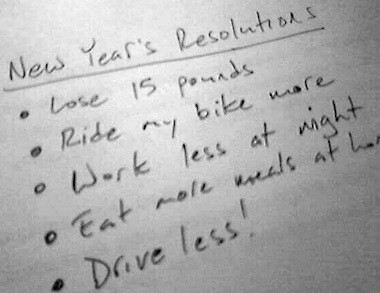
To Resolve or Not to Resolve

The New Year's Resolution...ah what a wonderful time that is.

I often ask during this time of year whether people engage in this activity or not. The responses I get are usually fairly interesting. Some answer yes, most no. But rather to my surprise most of them are somewhat tongue in cheek with regards to the resolutions that people profess to engage in (or have engaged in). It's almost as if people know they are doomed to failure or just have to laugh about previous attempts to conquer unrealistic expectations. Whatever the case, I had usually resigned myself to agree that the New Year's Resolution was of little to no value and therefore did NOT engage in such a practice. That was, until my college years.

I once had a conversation with a good friend of mine regarding the topic. In it he explained how he and his family sat down at their dining room table at the start of each year. It was at this table that each member of the family explained in detail to the others what his or her goals and desires were for the upcoming year. True goals...true desires. Suddenly the idea of becoming "resolved" about something at the beginning of the year took on new meaning. It didn't need to be simply trying to put an end to an unwanted habit or making a drastic life change in 2 weeks. It could be about working toward something real...something I was passionate about and desired to make a lasting change in.

So is it worth it? Making that decision? I believe it can be if the perspective is good, the motivation is right, and some helpful tools are utilized. Here are a few (though not an exhaustive list) tools to get started in the right direction.

The most important place to start, I have found, is finding something that is of importance to you. It must be something that has lasting value. If it does not, it will again become just another quickly discarded resolution. Once you've found depth in your direction, there are 3 other general tools to use:

1. Set a goal that is specific and measurable: if you don't you may never know if you've truly accomplished it.

2. Set both short and long term goals: starting with the end in mind and working your way backwards in order to "baby step" your way to the goal is helpful.

3. Set goals that are realistic yet lofty: if it doesn't stretch you, it's not a goal. But something too far fetched may be more of a discourager than an encourager. This may be an area where you seek advice in order to find out what a reasonable goal is (for example, knowing how much one can increase his/her vertical jump in a month or decrease bodyfat is wise to get input on).

4. Write it down: I've heard it said that it's only a wish until you get it on paper. And I might add that once you've got it written down, share it with those that are close to you so they can keep you accountable and encourage you along the way. Research shows that adherence to fitness goals can increase 200-300% when you are held accountable on a regular basis.

Apr 6, 2007

The Most Important Program Variable

Consistency...

You got it. That's IS it. The question is, do you HAVE it.

Those who know me or have trained with me over the years are most likely engaging in a bit of the ol' rolling of the eyes already..."Not this again, Chris." You better believe it. What is the saying?...you have to hear a message 10-15 times before it really starts sinking in...? What number is this for you? Tally it up and read on.


I have read a lot of books and research and programs and periodization information. They all have amazing and creative information regarding how to add 8 inches to your vertical in 2 months to dropping 10 lbs. in 2 weeks. And I have to tell you, there are some amazingly creative trainers out there. There really are. I have seen some of the most fantastic ideas about program design over the past couple years that I could have never come up with. But I have got to share a little news with you that over a decade of experience as well as research in the fields of performance and fitness have shown me...

It is NOT the program.

Don't get me wrong. Program design is one of the most valuable services I provide for my clients in order to avoid injury and adaptation as well as maximize progress. But if you take a look at any fitness magazine you are going to find the "latest" program to help you achieve the results you've always wanted. In my humble opinion (surprise surprise), this is just a marketing ploy to get you to buy the magazine. It's not the program that's the magic pill. There is a time and a place for program manipulation and adjustment. But if you want to maximize your results, folks, here is the answer you've been looking for:

Do something, do it regularly, and do it forever!

I know, I know. Not the most scientifically-based jargon you've ever heard. But you need to know something...IT WORKS! I have seen too many folks get caught up in the old "Paralysis by Analysis" trap to know that there is so much time lost in evaluation what one should do, where to start, etc. Just start. Get going. Quit waiting. And pick something that you can stick to for a while. Truth be told, for most people just starting out on a workout routine (whether it's for performance or fitness) you are going to see the greatest results and benefits in the first 4-6 months just from getting your body moving (even if you're not doing "the best" routine). And you'll find that you're going to continue to improve for a significant amount of time before adaptation starts to come into play and you are forced to change your program variables in order to achieve continued results.

Again, don't get me wrong. Is there value in getting started on the right foot, having a professional assessment and program designed that takes into consideration your goals and limitations?...Of course there is. That is one of my primary functions as a trainer. But don't get sucked into the idea that you have to be doing the latest exercise or routine that comes out in the magazine or trying to decide of the programs listed in the 15 different magazines you read which is the best to start with (by the way, the answer to that question is...whichever one you'll stick to longer than 3 months). Use those programs or tips as ideas and value them as ways to change your program to keep you interested. Why does that matter? Because if you are interested, you'll be...you got it...MORE CONSISTENT!

Now that I've said all that, you gotta be asking yourself, "Is this guy putting himself out of a job?" Simple answer...no. Truth be told, I'd rather have people come to me after they've plateaued on their program than starting from ground zero. My job is made easier then. However, the encouragement here is for lifelong improvement. My expertise comes in when the plateaus are reached, avoiding injury, evaluating if the program that is being performed has the best ratio of benefit to risk, and maximizing progress to achieve the goals most efficiently. My goals (unlike a lot of trainers out there) is to get people to their goals as efficiently as possible so that they are not dependent upon me. I want people to gain the tools and skills and know how so they can move to more independence and utilize me as a Training Consultant once or twice a month for continued progress and creative programs to keep it fun. Why? I can help more people this way.

I hope this helps. Now get going. And if you get stuck at a plateau or are concerned about injury avoidance...give me a call. Otherwise, what are you waiting for?

Mar 9, 2007

A Constant Reminder

This is not necessarily what I thought my inaugural post would be addressing. However, as I begin to lay it out I realize that it will most certainly not be the last of its kind, so I pray it speaks to you as it has spoken to me...

It struck me today...again...that nobody has it together. A friend of mine emailed me about how some difficult things are taking place in her life. She then proceeded to comment on a recent newsletter I sent out and how, in contrast to her own life, it appeared as though things were going so "well" for me. It truly gave me pause and reminded me how deceiving the exterior and facade of one's appearance can be to others. So much of my time lately has centered around the issues of this life as well as the need to live in constant submission to the One that is greater. There is no other way in which our time on this Earth can be more fully understood or lived.

It has also come to my attention once more about the need to be supported by others. Being able to share with and in the trials of life with close friends and family is not only necessity, but also a blessing of sorts. I have found that in the struggles and weaknesses of those times others are able to come alongside in order to aid in the healing process and uplift one until that person can once more stand up on his own.

Fortunately--for you the reader (tongue in cheek)--my thoughts in this are brought back to the world in which I live on a daily basis...that of health and wellness. And yes, even here I find strong correlations and lessons to be learned. It is true that no one part of life functions separately than another. We are created so closely intertwined and interwoven. And thus it holds true that our physical lives function very similarly to what I've already described. There are times of struggle. What does that time of struggle look like for you? I don't know. I know what it looks like for me, however. My point here is on how that struggle in the physical realms--albeit disease or ailment, lifelong struggles with weight or body image, or even the more "fun" hurdles of losing the last 4% bodyfat or increasing a vertical jump 5 inches--necessitates the support and aid of many. It is just simply unlikely that the goal (whatever it is) will ever be realized without those components. And this is also, unfortunately, why I see many people I've worked with or observed from a distance struggle month after month and year after year to achieve the allusive goal: an inability to surround themselves (or to be surrounded) by a supporting cast and to also be able to submit appropriately to things that are of more value or importance at given times (and therefore let their own pursuits fade into the background for a time).